Changes to Medicaid are coming.
Are you ready?
Medicaid changes begin January 1, 2027.
-
Most people with Medicaid will not lose coverage because of these immigration changes.
Some immigrants will continue to qualify for full Medicaid coverage if they meet all other Medicaid eligibility rules. This includes:
Lawful permanent residents (green card holders) who have completed the five-year waiting period or do not have to wait.
Cuban and Haitian entrants.
People from countries covered by the Compacts of Free Association (COFA).
Most pregnant people and children under age 21 who are lawfully living in Michigan will also continue to qualify for full Medicaid coverage.
If you are in one of these groups, you do not need to do anything unless you receive a notice from the Michigan Department of Health and Human Services (MDHHS).
Some immigrants who currently have full Medicaid coverage will no longer qualify for it under the new law. This includes many refugees, people granted asylum, and human trafficking survivors. Instead, they will receive Emergency Services Only (ESO) coverage.
Here is the full list of groups who will no longer qualify for Medicaid:
• Refugees
• Asylees
• Noncitizens paroled into the US for at least one year
• Noncitizens granted withholding of deportation
• Noncitizens granted conditional entry prior to 4/1/1980
• Noncitizens subject to battery or extreme cruelty by their US citizen or LPR relative
• Trafficking victims
• Amerasian immigrants
• Lawfully residing veterans/active-duty service members and certain family members
• American Indians born in Canada or American Indians who are members of a federally recognized tribe
• Humanitarian parolees1
• Other lawfully residing noncitizens
If you are in one of these groups and are currently covered by Medicaid, get the medical and dental care you need now before these changes take effect.


STAY ENROLLED
Changes to medicaid are coming.
But they do not start for most people until January 1, 2027.*
Right now, you still can:
Get Medicaid health coverage.
Sign up or renew your plan at MI Bridges.
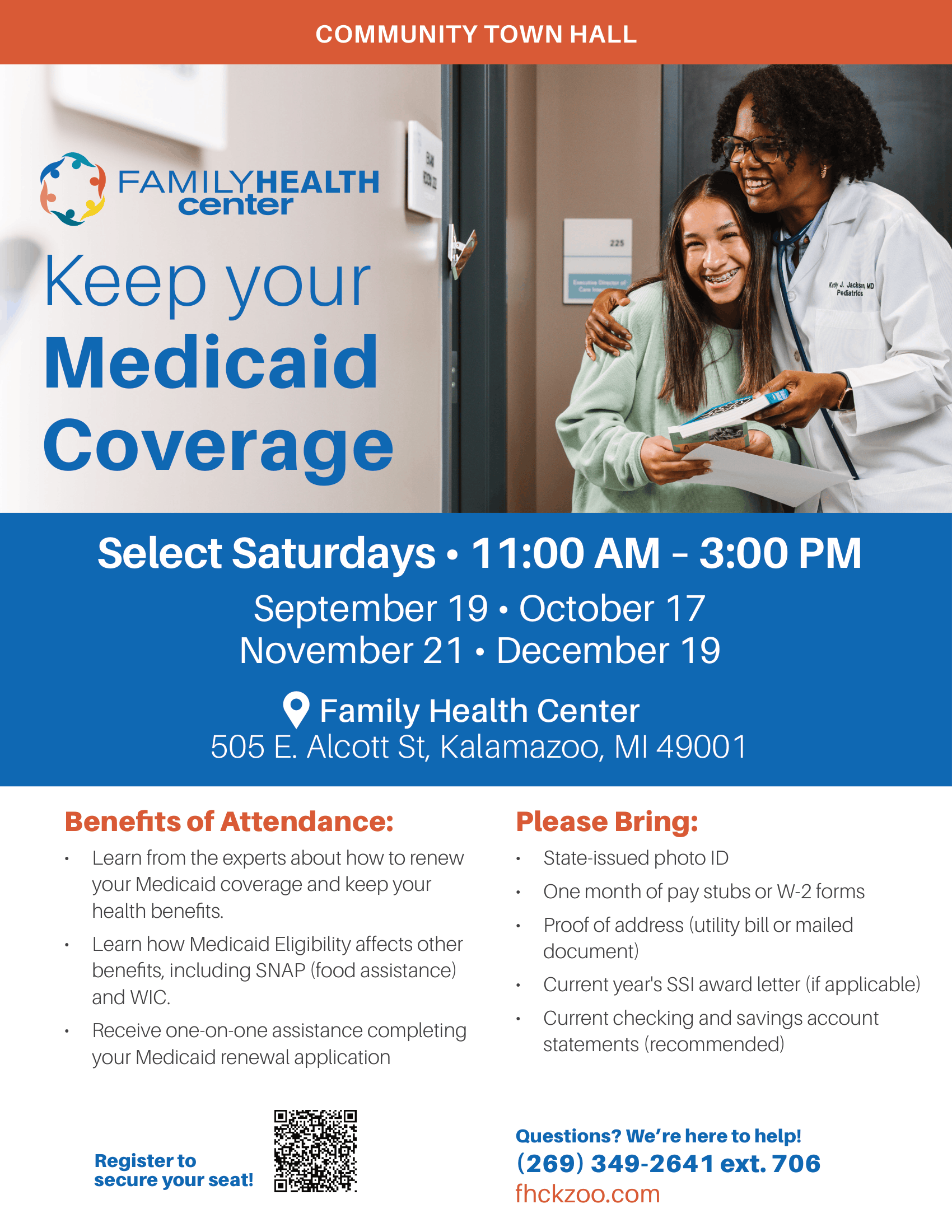
Get in-person help at a community event.
* Changes to Medicaid for some immigrant groups begin October 1, 2026
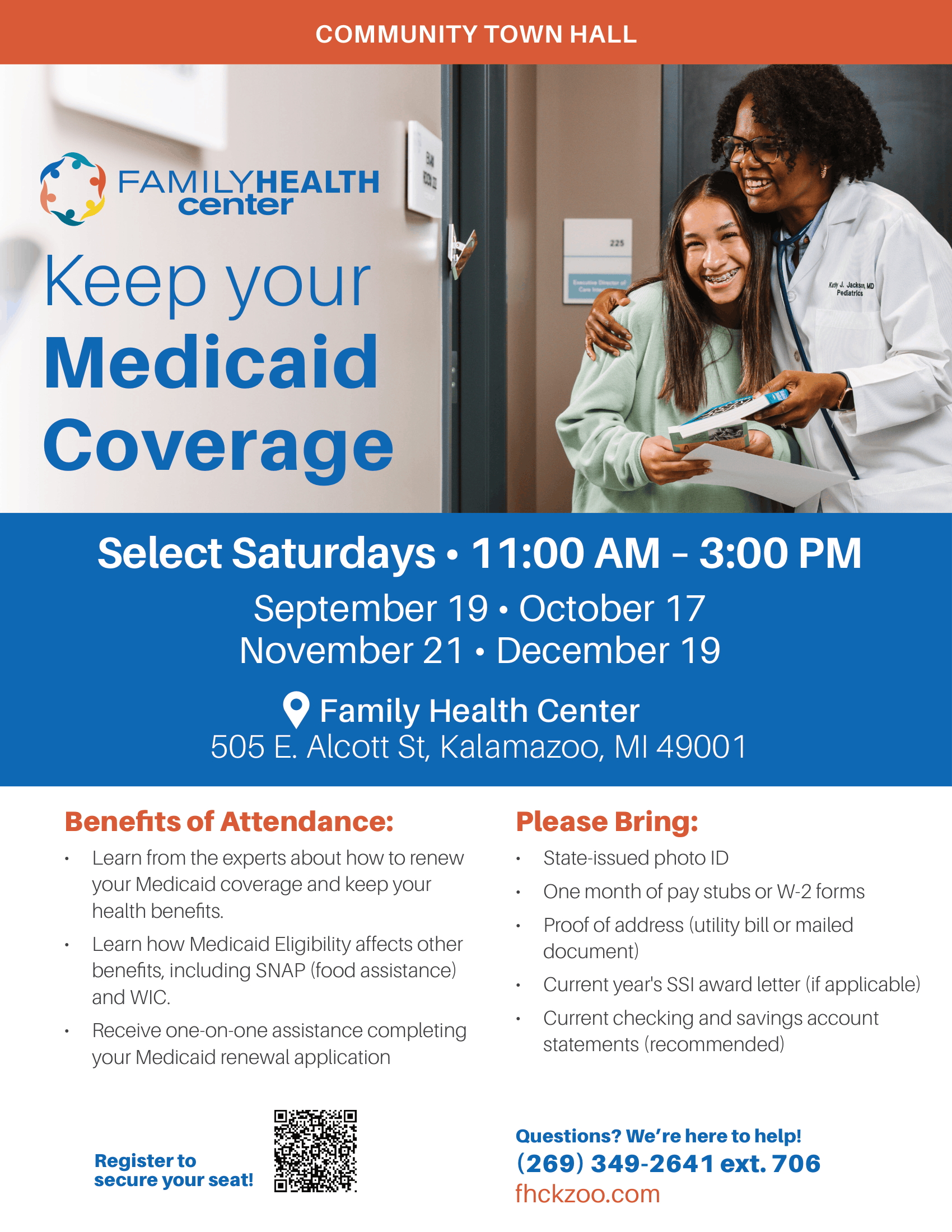
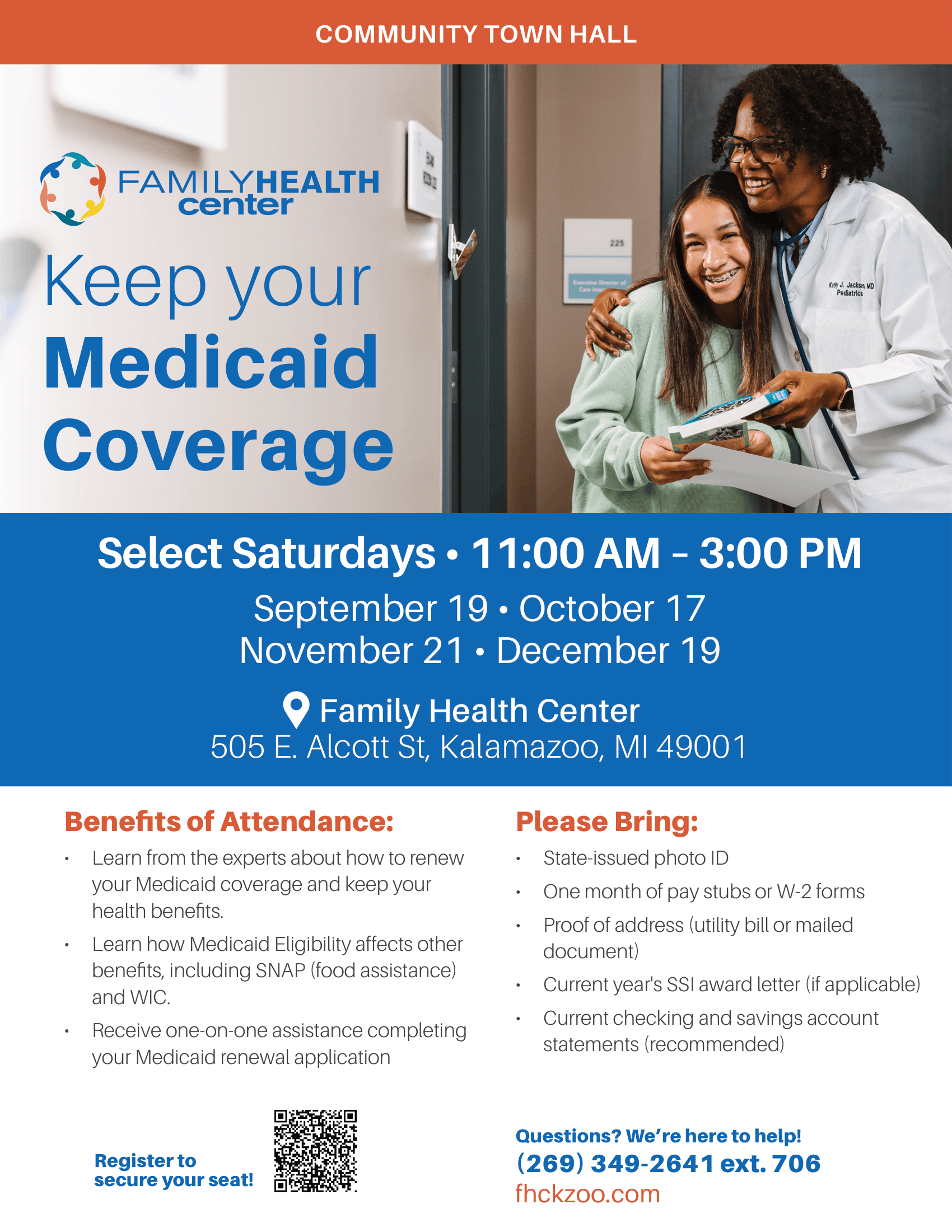
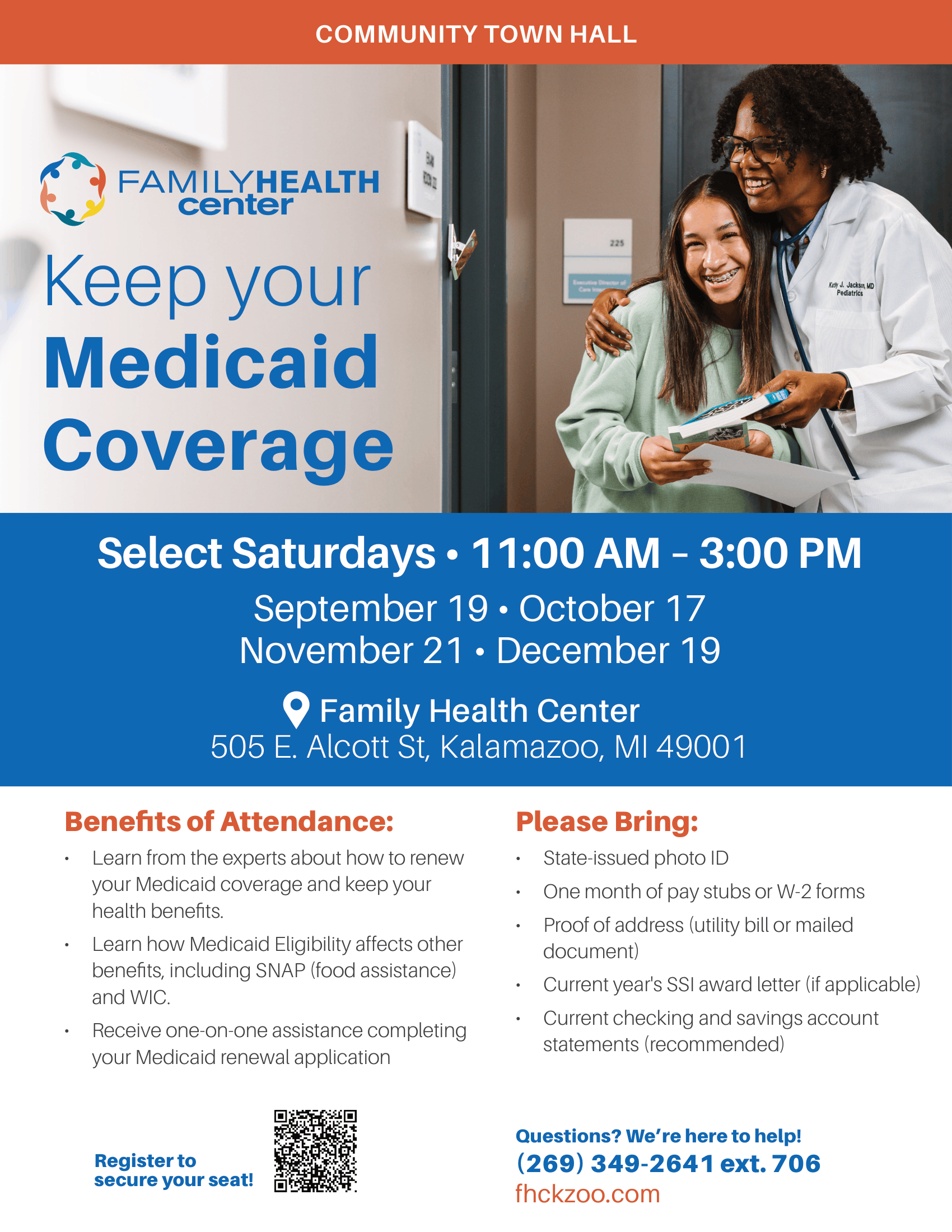
UPCOMING COMMUNITY EVENTS
STAY CONNECTED
The Michigan Department of Health and Human Services (MDHHS) will tell you if you have to do something new to keep your Medicaid.
The best thing you can do right now is stay connected. There is nothing more you need to do right now.
You can keep your information updated in these three ways:
Online

Log into MI Bridges to update your contact information.
See below for detailed instructions.
Phone

Call the MI Bridges Help Desk at 844-464-3447
(open M-F, 8 AM - 7PM)
In-Person

Visit the local MDHHS office at 427 E. Alcott Street (open M-F, 8 AM - 4:30 PM) to submit a paper change of address request.
How to Update Your Address In Mi Bridges:
Go to MI Bridges.
Log into your MI Bridges account.
From your dashboard, select Profile (or My Profile) and update your residential address and, if different, your mailing address.
Save your changes.
Return to your dashboard and select Report Changes.
Choose Address (or Address/Contact Information) as the type of change.
Enter your new address and review the information for accuracy.
Submit your changes.
Watch for a confirmation message indicating your update was received.
IMPORTANT: Updating your address in your Profile alone does NOT update your Medicaid or assistance case. You must also submit the change through Report Changes so your local MDHHS office can update your case.
Need Help?
If you don’t have a MiBridges account, select Register on the login page to create one.
If you’re unable to update your address online, contact your local MDHHS office for assistance.
MDHHS
Michigan Department of Health and Human Services
STAY INFORMED
Change can be confusing. We’re here to help.
Here are answers to some questions you might have about medicaid.
Download the Medicaid Eligibility Changes FAQ
-
Medicaid is a health insurance program run by the federal and state governments. It helps people with low incomes get health care. Medicaid covers many children, pregnant people, older adults, and people with disabilities. Medicaid also pays for many services, beyond health insurance, that benefit seniors, people with disabilities, and those with mental health or substance use disorders.
Nearly 1 in 4 people in the United States have Medicaid. In Michigan, more than 2.5 million people are covered by Medicaid. This includes children enrolled in MIChild, older adults and people with disabilities who qualify for Medicaid, and low-income adults covered by the Healthy Michigan Plan. The Healthy Michigan Plan began in 2014 when Michigan expanded Medicaid under the Affordable Care Act. This change allowed more low-income adults to get health insurance.
In Michigan, the Michigan Department of Health and Human Services (MDHHS) runs the Medicaid program, including the Healthy Michigan Plan.
-
In July 2025, Congress passed H.R. 1. The law changes who can qualify for Medicaid and what some people must do to keep their coverage. Most of these changes must be in place by January 1, 2027.
If you have Medicaid through the Healthy Michigan Plan, you may need to show that you are working, going to school, taking part in job training, or volunteering. (The law calls these “community engagement requirements,” but many people refer to them as work requirements.) Many people already meet the work requirement through work, school, job training, or other approved activities. Others qualify for an exemption.
People in the Healthy Michigan Plan will need to renew their coverage every six months instead of once a year.
Starting in October 2026, some immigrant groups will no longer qualify for Medicaid. (See “How Will the New Law Affect Immigrants?” FAQ.)
If your Medicaid coverage is changing, you will receive a notice by mail or by text if you signed up for text alerts through MI Bridges. If you receive a notice from MDHHS, read it carefully and respond by the deadline.
-
In Kalamazoo County, Healthy Michigan Plan (HMP) coverage is provided by United Healthcare, Meridian, McLaren Health Plan, and Aetna Better Health.
To see if you have HMP coverage you can do one of these things:Check your MI Bridges account.
Check your myHealthPortal or myHealthButton account.
Contact your health plan.
Call the beneficiary help line at: 1-800-642-3195.
-
MDHHS will contact people who are affected before any changes to their coverage take effect.
If the new Medicaid rules apply to you, MDHHS will let you know. You may receive a letter by mail or a text message if you signed up for text alerts through MI Bridges.
Right now, the most important thing you can do is keep your contact information up to date in MiBridges.
When you renew your coverage, you may be asked to update information such as your income or immigration status. If you do not complete your renewal or provide the requested information, you could lose your Medicaid coverage.
If you receive a notice from MDHHS, read it carefully and respond by the deadline.
-
Most people with Medicaid in Michigan will not see changes to their health coverage.
Starting January 1, 2027, some adults who have Medicaid through the Healthy Michigan Plan may need to show that they are working, going to school, taking part in job training, volunteering, or doing another approved activity. Some people may instead qualify for an exemption and will need to show that they meet the exemption.
The Michigan Department of Health and Human Services (MDHHS) will use information it already has to see who qualifies for an exemption. If it needs more information, MDHHS will contact you and ask for documents to confirm your eligibility.
Medicaid eligibility is decided for each person in a household. If one person's coverage changes, it does not automatically change coverage for other family members.
-
Some people do not have to meet the work requirements. This is called being exempt.
You may be exempt if you:
Already meet work requirements for SNAP (food assistance) or TANF (cash assistance).
Are pregnant or gave birth within the past 12 months.
Are a parent or caregiver of a child age 13 or younger.
Care for a person with a disability who needs help with daily activities.
Are an American Indian or Alaska Native.
Were in foster care when you turned 18 and are now younger than 26.
Are a veteran with a total disability.
Are in a treatment program for a substance use disorder.
Are in jail or prison or were released within the past three months.
Have a serious health condition or disability that makes it hard to work. This includes:
A physical, intellectual, or developmental disability.
A mental health condition.
A serious medical condition that requires ongoing treatment.
Being considered medically frail because of complex health needs.
You may also be exempt for a limited time if you are going through a temporary hardship, such as:
Staying in a hospital, nursing home, psychiatric hospital, or another care facility.
Traveling outside your community to get medical care because it is not available where you live.
Living in an area affected by a federally declared disaster.
Living in an area with high unemployment.
Other exemptions may apply. If you think you may qualify for an exemption, contact MDHHS. You can get more information about reporting exemptions at this website.
-
If the new work requirement applies to you, you must meet one of the following each month:
Work: Work at least 80 hours in a month or earn at least $580 before taxes during the month. Because of Michigan's minimum wage, many people can meet this requirement by working about 43 hours in a month.
School or job training: Be enrolled at least half time in college, a career training program, or a technical education program.
A work program: Take part in an approved work program for at least 80 hours in a month.
Community service: Volunteer for at least 80 hours in a month.
MDHHS will review your eligibility every six months.
If you are applying for Medicaid for the first time, MDHHS will look at the month before you apply. For example, if you apply in January 2027, you must show that you met the requirement in December 2026.
After you are enrolled, MDHHS will review your eligibility every six months. To keep your coverage, you must show that you met the requirement during at least one of the previous six months.
-
Beginning in 2027, many people in the Healthy Michigan Plan will need to renew their Medicaid coverage every six months instead of once a year.
When it is time to renew, MDHHS will send you a notice with instructions. Be sure to complete and return any forms by the deadline. If you do not respond, you could lose your Medicaid coverage.
That is why it is important to keep your mailing address, phone number, and email address up to date in your MI Bridges account.
If you receive a notice from MDHHS, read it carefully and respond by the deadline.
-
Most people with Medicaid will not lose coverage because of these immigration changes.
Some immigrants will continue to qualify for full Medicaid coverage if they meet all other Medicaid eligibility rules. This includes:
Lawful permanent residents (green card holders) who have completed the five-year waiting period or do not have to wait.
Cuban and Haitian entrants.
People from countries covered by the Compacts of Free Association (COFA).
Most pregnant people and children under age 21 who are lawfully living in Michigan will also continue to qualify for full Medicaid coverage.
If you are in one of these groups, you do not need to do anything unless you receive a notice from the Michigan Department of Health and Human Services (MDHHS).
Some immigrants who currently have full Medicaid coverage will no longer qualify for it under the new law. This includes many refugees, people granted asylum, and human trafficking survivors. Instead, they will receive Emergency Services Only (ESO) coverage.
-
Emergency Services Only (ESO) covers treatment for a medical emergency. A medical emergency is a serious health problem that needs immediate care to prevent severe harm to your health.
ESO does not cover:
Regular doctor visits.
Checkups and preventive care.
Ongoing care for long-term health conditions.
Most prescription medicines.
Medical care that is not an emergency.
If your coverage is changing to Emergency Services Only, MDHHS will send you a notice before the change takes effect.
Medicaid eligibility is decided separately for each person in a household. If one person's coverage changes, it does not automatically change coverage for other family members.
Undocumented immigrants are not eligible for Medicaid and have not been eligible under federal Medicaid rules.
If you receive a notice from MDHHS, read it carefully and respond by the deadline. For more information, visit MDHHS.
-
Whether you qualify for Medicaid depends on several things. The Michigan Department of Health and Human Services (MDHHS) looks at your:
Household income.
Number of people in your household.
Age.
Whether you are pregnant or have a disability.
Whether you live in Michigan.
Your citizenship or immigration status.
Different Medicaid programs have different rules.
For the Healthy Michigan Plan, there is no asset limit. This means that things like your savings or your car usually do not affect whether you qualify.
Healthy Michigan Plan income guidelines for 2026
Based on the number of people in your household, your yearly income must be this or less:
1 | $22,025
2 | $29,863
3 | $37,702
4 | $45,540
5 | $53,378
6 | $61,217
These income amounts are estimates. MDHHS will make the final decision based on your household's income and other eligibility rules.
-
You can still apply for Medicaid or renew your current coverage if you qualify. If you are considering applying for Medicaid, there are benefits to doing so before January 1, 2027.
Keep your contact information up to date in MI Bridges. If you need to create a MI Bridges account, see the FAQ "How do I create a MI Bridges account?"
-
If you lose your Medicaid coverage, you may be able to apply again.
You may qualify if your situation changes. For example, you may become eligible if:
Your income changes.
You become pregnant.
You develop a disability or another health condition that affects your eligibility.
If you think you may qualify again, apply through MI Bridges or contact MDHHS for help.
-
To use MI Bridges, you first need a MiLogin account. MiLogin is the sign-in system used for MI Bridges and other Michigan state services.
Follow these steps:
Go to the MI Bridges website.
Select Create an Account.
You will be taken to the MiLogin page. Select Create an Account and follow the instructions.
Enter the requested information, such as your:
Name
Date of birth
Email address
Phone number (if requested)
Social Security number or Case ID (if you have a Medicaid or other MDHHS case)
Create a username and password.
Choose your security questions and how you want to receive updates (email, text, or both).
Complete any identity verification steps, if asked.
Accept the terms and finish creating your account.
After your account is set up, you can:
Apply for benefits.
Check your case status.
Upload documents.
Update your information.
Read notices from MDHHS.
If you already have a MiLogin account for another Michigan state service, you can use the same username and password to sign in to MI Bridges.
If you need help, contact the MI Bridges Help Desk or call 1-844-799-9876.